
Manhattan Real Estate Market
Manhattan Real Estate: Co-ops, Condos and Townhouses Across New York County
Manhattan, which is New York County, is New York City’s most densely populated borough, running from Inwood and Washington Heights down to the Financial District and Battery Park. Phases & Spaces helps buyers and sellers across Manhattan’s neighborhoods with careful, local pricing.
Most Manhattan homes are apartments, and co-ops and condos make up the large majority of sales. Housing ranges from pre-war co-op buildings and newer condo towers to converted lofts and historic brownstone and limestone townhouses. Because building type, amenities, board rules and monthly costs vary so much, two apartments a few blocks apart may compare very differently.
Below is an overview of the neighborhoods we see most often, the types of homes you’ll find, and practical tips whether you’re buying or selling.
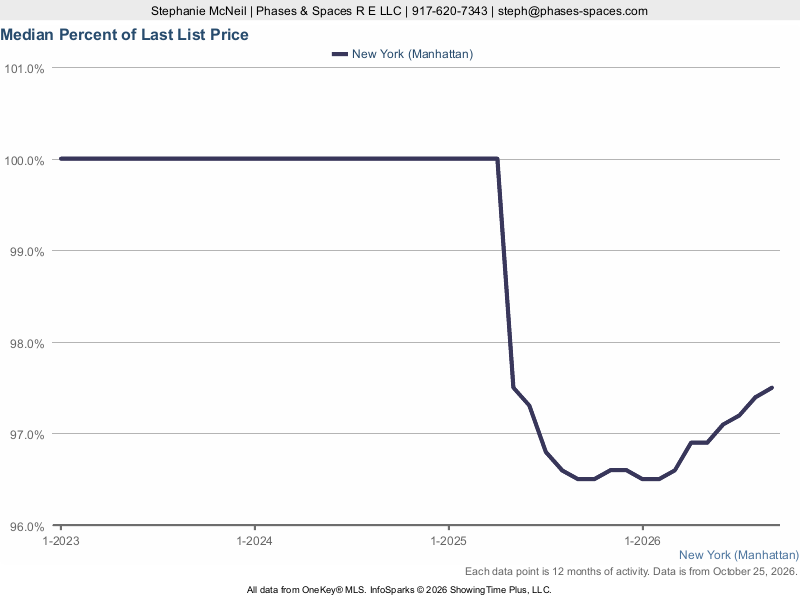
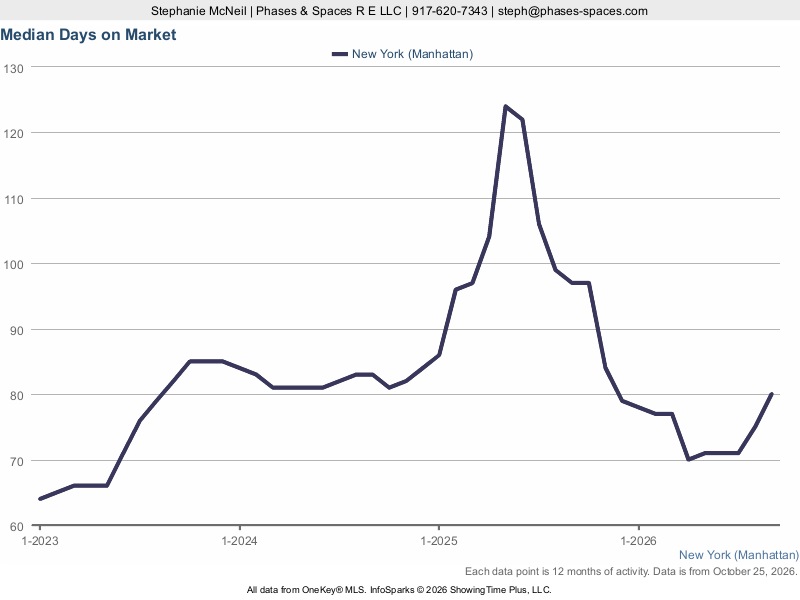
Manhattan Market Snapshot
Houses, condos & co-ops · rolling 12 months · updates automatically
Ryan & Stephanie McNeil · Phases & Spaces Real Estate · 347-508-8111 · [email protected]
Source: OneKey MLS, New York County, all residential property types, rolling 12 months through September 2026: median 97.5% of list price received and median 80 days on market. Many Manhattan sales are listed outside OneKey MLS, so these figures reflect only sales reported there. Charts update automatically.
Manhattan Neighborhoods at a Glance
- Upper East Side — Pre-war co-ops along Park and Fifth Avenues, townhouses on side streets and newer condos; 4/5/6 trains and the Q along Second Avenue.
- Upper West Side — Pre-war co-op buildings, brownstones and newer condos between Central Park and Riverside Park; 1/2/3 and B/C trains.
- Harlem — Historic brownstone and row houses, many multi-family, plus co-ops and newer condo buildings; 2/3, A/B/C/D and 4/5/6 trains, plus Metro-North at Harlem–125th Street.
- Washington Heights — Pre-war co-op buildings and rentals near Fort Tryon Park and the Hudson; A and 1 trains.
- Midtown — High-rise condo towers and co-op buildings near the main business districts, Penn Station and Grand Central; many subway lines plus LIRR and Metro-North.
- Chelsea — Townhouses, pre-war co-ops, converted lofts and newer condos near the High Line; 1, C/E, L and F/M trains.
- Greenwich Village — Historic townhouses, pre-war co-ops and condos within designated landmark districts around Washington Square Park; A/C/E, B/D/F/M and 1 trains.
- Financial District — Office buildings converted to condos and rentals, plus newer condo towers near the waterfront; many subway lines, PATH and NYC Ferry.
Housing Types in Manhattan
Co-ops
Co-ops are a large share of Manhattan’s apartment stock, especially in pre-war buildings. Buyers purchase shares in the building’s corporation, pay monthly maintenance and must be approved by the co-op board, which sets its own financing and financial requirements.
Condos and Lofts
Condo buildings range from converted lofts to newer high-rise towers with doorman and amenity packages. Condos are owned as real property, with common charges and separate tax bills, and typically have fewer approval steps than co-ops.
Townhouses
Brownstone, limestone and brick townhouses are found in many older neighborhoods. Some are single-family and others have multiple units, and original details and condition vary widely by house.
Living in Manhattan
Getting Around
Manhattan is served by most MTA subway lines, MTA buses, the LIRR and NJ Transit at Penn Station, the LIRR at Grand Central Madison, Metro-North at Grand Central, PATH trains and NYC Ferry. Drivers use the FDR Drive, the Henry Hudson Parkway and the bridges and tunnels to the other boroughs and New Jersey. Commute times depend heavily on the line and station, so we suggest test runs.
Schools
Public schools in Manhattan are part of the New York City Public Schools system, and zoned schools are assigned by address. Confirm the zoned school for any specific address with NYC Public Schools. We don’t rate schools; we help you find the official information for each address.
Taxes and Local Government
Property taxes in Manhattan are set by New York City. The NYC Department of Finance assesses each property and assigns a tax class, with most one- to three-family homes in Class 1 and most other residential property, including co-ops and condos, in Class 2. Assessment appeals go to the NYC Tax Commission. Review the actual tax bill and any exemptions when comparing homes.
Lifestyle and Amenities
Manhattan offers Central Park, Riverside Park, the High Line, Hudson River Park, Washington Square Park, Fort Tryon Park and the Cloisters, and major museums such as the Metropolitan Museum of Art, along with busy commercial streets and waterfront paths.
Tips for Buying and Selling in Manhattan
For Buyers
- For co-ops, expect a detailed board package with financial statements, tax returns and references, plus a board interview; ask early about down payment, debt-to-income and post-closing liquidity requirements.
- Budget for closing costs such as the New York State mansion tax on purchases of $1 million or more and mortgage recording tax on financed condo and house purchases; your attorney will confirm the amounts.
- Review the building’s financials, reserve fund, any planned assessments and sublet or pet policies before you commit.
- Check whether a property is in a designated landmark district, since exterior changes may need NYC Landmarks Preservation Commission approval.
- Review the current tax bill and common charges for condos, or a co-op’s maintenance breakdown.
- Read our Buyer’s Guide for a step-by-step look at offers, inspections, attorney review and closing in New York.
For Sellers
- Price from recent, truly comparable sales in your own neighborhood and building type, not borough-wide averages.
- Plan for New York State and New York City transfer taxes, which sellers generally pay; your attorney will confirm the amounts.
- For co-ops, gather the offering plan, financials, house rules and any flip tax details before listing.
- For condos, request the building’s resale package and any right-of-first-refusal steps early to avoid delays.
- See our Seller’s Guide or start with a free home valuation, and visit our selling page for how we market homes.
Manhattan Real Estate FAQ
What areas of Manhattan does Phases & Spaces serve?
We work throughout Manhattan, including the Upper East Side, Upper West Side, Harlem, Washington Heights, Midtown, Chelsea, Greenwich Village and the Financial District, as well as the many other neighborhoods across the borough.
How fast are Manhattan homes selling right now?
According to OneKey MLS data for the rolling 12 months through September 2026, Manhattan (New York County) homes sold at a median of 97.5% of list price with a median of 80 days on market. Many Manhattan sales are listed outside OneKey MLS, so these figures reflect only the sales reported there. Conditions vary by neighborhood, building and property type, so we review local comparable sales for any specific home.
How do property taxes work in Manhattan?
Manhattan property taxes are set by New York City. The NYC Department of Finance assesses each property and assigns a tax class: Class 1 for most one- to three-family homes and Class 2 for most other residential property, including co-ops and condos. Owners who disagree with an assessment can appeal to the NYC Tax Commission during the annual filing period. Always review the actual tax bill, or a co-op’s maintenance breakdown, for any home you are considering.
What closing taxes apply when buying or selling in Manhattan?
Sellers generally pay New York State and New York City real property transfer taxes. Buyers of residential property at $1 million or more generally pay the New York State mansion tax, and buyers using a mortgage on a condo or house generally pay mortgage recording tax. Your real estate attorney will confirm the exact amounts for your transaction.
How do I find out what my Manhattan home is worth?
Request a free home valuation. We compare your home with recent nearby sales of similar size, building type and condition, not just list prices.
Thinking About a Move in Manhattan?
Phases & Spaces Real Estate, Ryan & Stephanie McNeil, serves Queens, Nassau County and greater NYC from our office at 61-43 186th Street, Suite 504, Fresh Meadows, NY 11365. Call 347-508-8111, email [email protected], or pick a next step below.

Phases & Spaces Real Estate
61-43 186th Street, Suite 504
Fresh Meadows, NY 11365



Real Estate Markets
Queens, NY
Brooklyn, NY
Manhattan, NY
Bronx, NY
Staten Island, NY
Nassau County, NY
Suffolk County, NY
Westchester County, NY
Sullivan County, NY
quick links & Resources
Buy a Home
Home Valuation
Sell Your Home
Lease a Property
Search Properties
Homebuyer's Guide
Seller's Guide
Schedule a Consultation
© Copyright 2013 - 2026 All Rights Reserved. | Website Designed & Powered by Phases & Spaces Real Estate.
Privacy Policy | Terms of Use | | Consent to Electronic Communications | Fair Housing Statement | SOP | Agency Disclosure